Choosing the right syringe begins with a simple question: what are medical syringes made of? In 2026, most disposable syringes use medical-grade polypropylene for the barrel and polyethylene for the plunger. These plastics are lightweight, transparent, and compatible with common sterilization processes. The rubber stopper may contain natural rubber or synthetic elastomers, depending on the manufacturer and intended use. Needles usually combine stainless steel with carefully engineered bevels and hubs.
Small details matter.
A clear barrel helps clinicians inspect liquid volume, air bubbles, and unusual particles before use. Low-friction plungers can support smoother dosing, especially during repeated procedures. However, no material is perfect. Some plastics may interact with sensitive medicines, while certain elastomers can release trace substances into specific formulations. These concerns require validated compatibility testing, not guesswork.
This guide compares syringe materials, designs, and applications across hospitals, laboratories, pharmacies, and home-care settings. It considers safety, sterility, chemical resistance, dose accuracy, environmental impact, and handling comfort. Reliable evaluations should refer to manufacturer specifications, quality-control records, and recognized standards such as ISO 7886 where applicable. Clinical experience also matters, because a syringe that performs well in a laboratory may feel difficult during real-world use.
The “best” syringe depends on the medicine, volume, route, and storage conditions. That answer is less convenient, but more accurate. Readers will also see where current materials remain limited, particularly regarding waste reduction and advanced drug compatibility.
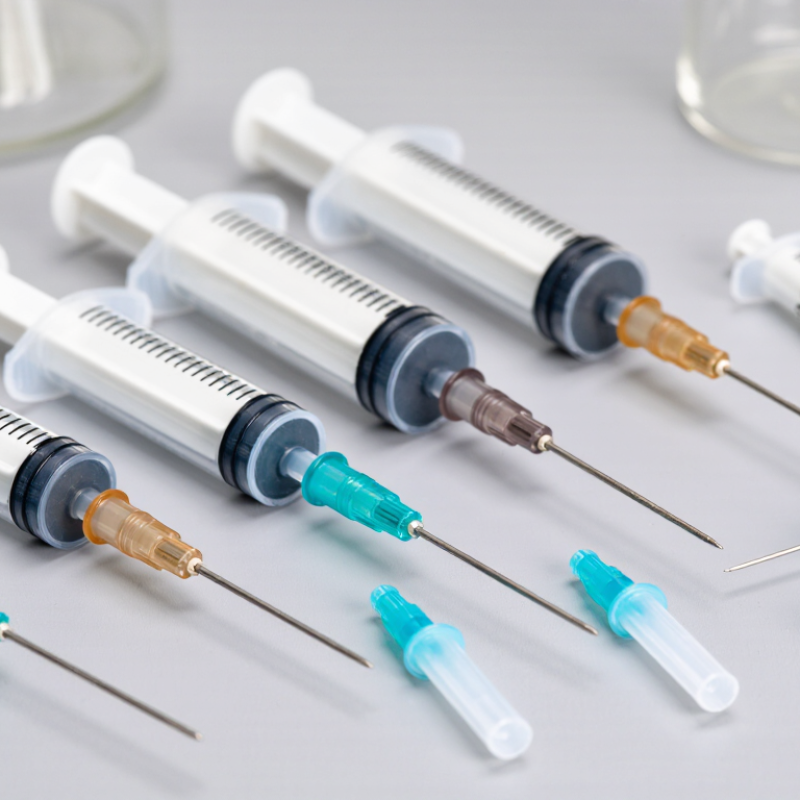
Medical syringe materials determine safety, accuracy, and handling during clinical use. Polypropylene is common for disposable barrels because it is lightweight, transparent, and chemically resistant. It also tolerates many sterilization processes. However, some medicines may interact with plastic surfaces or absorb into them. That possibility deserves careful testing.
Glass offers strong dimensional stability and excellent visibility. It suits sensitive formulations that require low extractables or long storage periods. Yet glass can break, adds weight, and demands careful transport. Small chips are unacceptable. Elastomers usually form plungers, gaskets, or protective caps. Their flexibility creates a reliable seal, but rubber-like materials can release compounds or react with specific drugs. Formulation compatibility matters more than appearance.
Steel is widely used for needles because it provides strength, sharpness, and controlled penetration. Its surface finish affects comfort and flow. In practice, material selection should consider viscosity, storage time, sterilization, temperature, and dosage accuracy. A clear barrel is not automatically the best barrel. A strong needle is not enough if the seal leaks. Testing should examine particles, leakage, extractables, and repeated movement under realistic conditions. No material wins every test. A careful choice may still involve compromise. Manufacturers and healthcare teams should review technical data, validated performance, and applicable medical-device requirements before use.
Polypropylene syringes remain a practical choice for many medical applications in 2026. The material is lightweight, chemically resistant, and suitable for transparent barrels. It also tolerates common sterilization and manufacturing processes when properly validated. For sizes from 0.5 to 60 mL, ISO 7886-1 provides a framework for evaluating essential performance. This includes graduated capacity, leakage, plunger movement, dead space, and resistance to separation.
Small 0.5 mL syringes require especially clear graduations and controlled plunger movement. A tiny reading error can change the delivered volume noticeably. Larger 20, 30, and 60 mL syringes need stronger barrel walls and stable flange design. Smooth operation matters too. Excessive force may affect handling, while loose movement can reduce control. Qualified manufacturers should verify these properties through documented inspections and performance testing, not visual checks alone.
No material is perfect. Polypropylene can show dimensional variation if molding conditions drift. That assumption needs testing. Temperature, storage time, and sterilization exposure may influence fit between the stopper and barrel. ISO 7886-1 testing supports comparison, but it does not replace application-specific validation. Hospitals and device evaluators should review test records, material specifications, cleanliness controls, and packaging integrity. A clear barrel is useful, yet clarity alone cannot prove accuracy or safety. The most reliable selection combines polymer quality, consistent assembly, calibrated testing, and realistic use simulations across the full 0.5–60 mL range.
Polypropylene is widely used for disposable syringe barrels because it is lightweight, chemically resistant, and suitable for medical-device manufacturing. The chart compares common nominal syringe capacities from 0.5 mL to 60 mL. ISO 7886-1 defines performance and functional requirements for sterile, single-use manual syringes; it does not require one specific polymer or guarantee identical graduation accuracy across every capacity.
Capacities shown are nominal barrel sizes commonly used in ISO 7886-1 syringe formats. Actual graduation intervals, dead space, plunger design, and product specifications may vary by syringe configuration.
Glass syringes remain important for sensitive injectable medicines in 2026. USP General Chapter <660> identifies Type I borosilicate glass as highly resistant to hydrolysis. Its strict test uses acid extraction to evaluate glass stability. This matters when formulations contain extreme pH levels, salts, or long storage periods. FDA guidance on container-closure systems also recommends studying extractables, leachables, and drug interaction risks. Glass is transparent, rigid, and chemically stable. However, it is not automatically the safest choice.
During syringe qualification, specialists examine the barrel, plunger, stopper, and lubricant together. A stable glass surface can still face issues from silicone oil, tungsten residues, or protein adsorption. PDA Technical Report No. 66 highlights the need to assess syringe functionality and product compatibility as a complete system. Small differences may affect break-loose force, dose accuracy, and visible particles. That detail is often underestimated.
Tips: Request USP Type I documentation and review the glass hydrolytic-resistance test results. Compare the syringe with the actual formulation, not pure water. Test filled units under intended temperature, light, and storage duration. Inspect for delamination, particles, and stopper interaction. A compatibility study may reveal an uncomfortable result: the glass performs well, but another component does not.
Medical syringes commonly use stainless steel needle tubing because it combines strength, cleanliness, and controlled flexibility. ISO 9626 specifies requirements and test methods for stainless steel tubing used in medical needles. The needle includes a hollow tube, sharpened bevel, and polished surface. A clean bevel should enter skin smoothly, without visible burrs or rough edges.
Gauge affects both comfort and flow. A 25G needle is thicker than a 33G needle. Typical outside diameters range from about 0.5 millimeters at 25G to 0.2 millimeters at 33G, depending on wall design. Thinner walls can preserve internal flow while reducing the outside diameter. Insulin needles commonly use 28–33G sizes, but selection depends on injection depth, medication viscosity, and device compatibility. Very thin is not automatically better.
The International Diabetes Federation reported 589 million adults living with diabetes in 2024, with the number projected to reach 853 million by 2050. This growing need makes consistent needle construction more important. WHO estimates that roughly 16 billion injections occur globally each year, highlighting the value of reliable materials and manufacturing controls. In practical inspection, I would check the bevel, tubing straightness, hub fit, and package integrity. Gauge alone is not a quality score. Small defects matter. Even ISO-compliant tubing can perform poorly if sharpening or assembly is inconsistent.
| Category | Component or Gauge | Typical Material or Standard | Typical Dimensions | Key Performance Characteristics | Common Selection Considerations |
|---|---|---|---|---|---|
| Syringe Body | Barrel | Medical-grade polypropylene; some specialty products use glass | Common capacities: 0.3, 0.5, 1, 3, 5, 10, 20 and 50/60 mL | Lightweight, chemically resistant and transparent enough for dose inspection | Choose based on volume accuracy, medication compatibility, visibility and need for low extractables |
| Plunger rod | Polypropylene or another medical-grade polymer | Sized to match the barrel and nominal syringe capacity | Provides controlled movement and dose delivery | Evaluate smooth travel, rod strength and compatibility with the stopper or gasket | |
| Piston gasket or stopper | Synthetic elastomer, commonly halobutyl rubber or similar medical-grade elastomer | Diameter matched to the internal barrel diameter | Creates a fluid-tight seal and supports smooth, consistent motion | Check drug-contact compatibility, particle shedding, extractables and break-loose force | |
| Needle hub | Medical-grade polypropylene, polycarbonate or another suitable polymer | Hub geometry depends on fixed-needle or detachable-needle design | Connects the needle securely to the syringe or needle interface | Select for connection security, dead-space control and resistance to leakage | |
| Protective needle cap | Polypropylene or polyethylene | Length and internal diameter are matched to the needle assembly | Protects the needle before use and helps maintain package integrity | Verify secure retention, easy removal and compatibility with sterile packaging | |
| Needle Construction | Needle tube | Austenitic stainless-steel tubing manufactured to ISO 9626 requirements | Outside diameter and wall thickness are selected by gauge and needle application | High strength, corrosion resistance, cleanability and reliable penetration performance | Confirm applicable ISO 9626 dimensions, tube condition, surface finish and intended clinical use |
| 25G insulin or injection needle | ISO 9626 stainless-steel needle tube | Nominal outside diameter: approximately 0.51 mm; common short-needle lengths vary by application | Higher flow potential and greater rigidity than finer gauges | Used when a comparatively robust needle and faster flow are needed; not usually the first choice for routine subcutaneous insulin delivery | |
| 26G insulin or injection needle | ISO 9626 stainless-steel needle tube | Nominal outside diameter: approximately 0.46 mm | Balanced stiffness and flow compared with finer gauges | Consider for applications requiring more rigidity than 30–33G needles | |
| 27G insulin or injection needle | ISO 9626 stainless-steel needle tube | Nominal outside diameter: approximately 0.40 mm | Moderate outer diameter with useful structural strength | A practical compromise when handling strength and injection comfort both matter | |
| 28G insulin or injection needle | ISO 9626 stainless-steel needle tube | Nominal outside diameter: approximately 0.36 mm | Smaller diameter can reduce tissue disruption while maintaining reasonable rigidity | Often considered when a balance between comfort, flow and needle strength is required | |
| 29G insulin or injection needle | ISO 9626 stainless-steel needle tube | Nominal outside diameter: approximately 0.33 mm | Fine profile with lower expected insertion force than larger gauges | Suitable where a fine needle is preferred, provided the required dose can be delivered efficiently | |
| 30G insulin or injection needle | ISO 9626 stainless-steel needle tube | Nominal outside diameter: approximately 0.30 mm | Fine needle designed for low-volume subcutaneous delivery | Commonly evaluated for insulin delivery when comfort and short needle length are priorities | |
| 31G insulin or injection needle | ISO 9626 stainless-steel needle tube | Nominal outside diameter: approximately 0.25 mm | Very fine profile with greater flow resistance than larger gauges | Useful for small-volume injections; injection time and needle flexibility should be assessed | |
| 32G insulin or injection needle | ISO 9626 stainless-steel needle tube | Nominal outside diameter: approximately 0.23 mm | Extremely fine needle intended for low-volume delivery | Consider injection duration, bending resistance and compatibility with the intended formulation | |
| 33G insulin or injection needle | ISO 9626 stainless-steel needle tube | Nominal outside diameter: approximately 0.20 mm | Smallest gauge in this range; may help minimize insertion discomfort but has higher flow resistance | Best suited to compatible low-volume applications after confirming dose accuracy and acceptable delivery time | |
| Technical note: Gauge outside diameters are nominal reference values commonly used for medical needle sizing. Actual wall thickness, bevel geometry, needle length, flow rate and performance depend on the specific design and applicable product requirements. Needle selection should be validated for the intended route, medication, dose and user population. | |||||
Best 2026 Syringe Types by Sterility, Dose, Material, and Clinical Use
Most medical syringes use medical-grade polypropylene barrels, synthetic rubber stoppers, and stainless-steel needles. Glass remains useful for sensitive medicines and prefilled systems. It offers strong chemical stability, but it adds weight and breakage risk. No material wins every case. Selection depends on sterility, medication compatibility, and handling conditions.
Sterile, single-use syringes remain the safest routine choice for injections. WHO estimates that about 16 billion injections occur globally each year, with many used for therapeutic care. Its injection-safety guidance stresses preventing reuse and contamination. Prefilled syringes can improve dose accuracy and reduce preparation steps. However, they may cost more and create storage challenges. A clean package is not enough; staff must also verify the seal, expiry date, and clarity of the medicine.
Dose and clinical purpose should guide the barrel size. A 1 mL tuberculin syringe supports small, precise volumes. Insulin syringes commonly use 0.3, 0.5, or 1 mL capacities. Standard 3 mL syringes suit many routine injections, while 5 mL and larger models support irrigation or fluid transfer. CDC infection-control guidance favors single-use equipment for patient care. ISO 7886-1 also defines performance requirements for sterile, single-use hypodermic syringes. These standards help, but they cannot replace practical training. Procurement teams sometimes choose the cheapest option first. That decision deserves another look.
It is lightweight, transparent, and chemically resistant. It also tolerates several validated sterilization processes. Plastic is not perfect. Some medicines may interact with its surface or absorb into it.
Glass provides strong dimensional stability and clear visibility. It suits sensitive formulations and longer storage periods. However, it adds weight. Breakage and tiny chips require strict inspection.
Elastomers commonly form plungers, gaskets, or protective caps. Their flexibility helps create a reliable seal. Compatibility matters more than appearance. Some rubber-like materials may release compounds or react with medicines.
No. Clarity improves visibility, but it cannot confirm accurate dosing or safe performance. That shortcut can fail. Testing should examine capacity, leakage, particles, and plunger movement.
Small syringes, such as 0.5 mL models, need very clear graduations. Tiny reading errors can noticeably change delivered volume. Larger sizes need stronger walls. Flange stability and smooth movement also matter from 20 to 60 mL.
Gauge describes needle size. A 25G needle is thicker than a 33G needle. Typical outside diameters range from about 0.5 to 0.2 millimeters. Thinner is not automatically better. Viscosity, injection depth, and device compatibility also matter.
Stainless steel provides strength, cleanliness, and controlled flexibility. A polished surface and clean bevel support smoother entry. Small defects matter. Burrs, rough edges, or poor straightness can affect performance.
Review viscosity, storage time, temperature, sterilization exposure, and dosage accuracy. Check leakage, extractables, particles, and repeated movement. Inspect the seal too. Technical records and realistic use simulations are more reliable than visual checks alone.
No. Standard-based testing supports comparison, but application-specific validation remains necessary. Conditions can change. Manufacturers and healthcare teams should review material data, packaging integrity, cleanliness controls, and validated performance.
Medical syringes are primarily made of polypropylene, borosilicate glass, elastomeric components, and stainless steel. When asking “what are medical syringes made of,” the best answer depends on the intended clinical use. Polypropylene syringes are lightweight, disposable, and available in sizes from 0.5 to 60 mL, with performance commonly evaluated under ISO 7886-1. Glass syringes, especially USP Type I borosilicate glass, offer strong chemical resistance and reliable compatibility with many medications.
Needle construction is another important consideration. Stainless steel needles are commonly manufactured according to ISO 9626, while 25–33G needles are often selected for insulin delivery and other applications requiring fine, controlled dosing. In 2026, the best syringe type should be chosen according to sterility requirements, dose accuracy, material compatibility, and clinical purpose. Polypropylene is generally practical for routine single-use procedures, glass is valuable for sensitive formulations, elastomers support secure sealing, and steel provides strength and precision in needle systems.

JZCare Syringe